
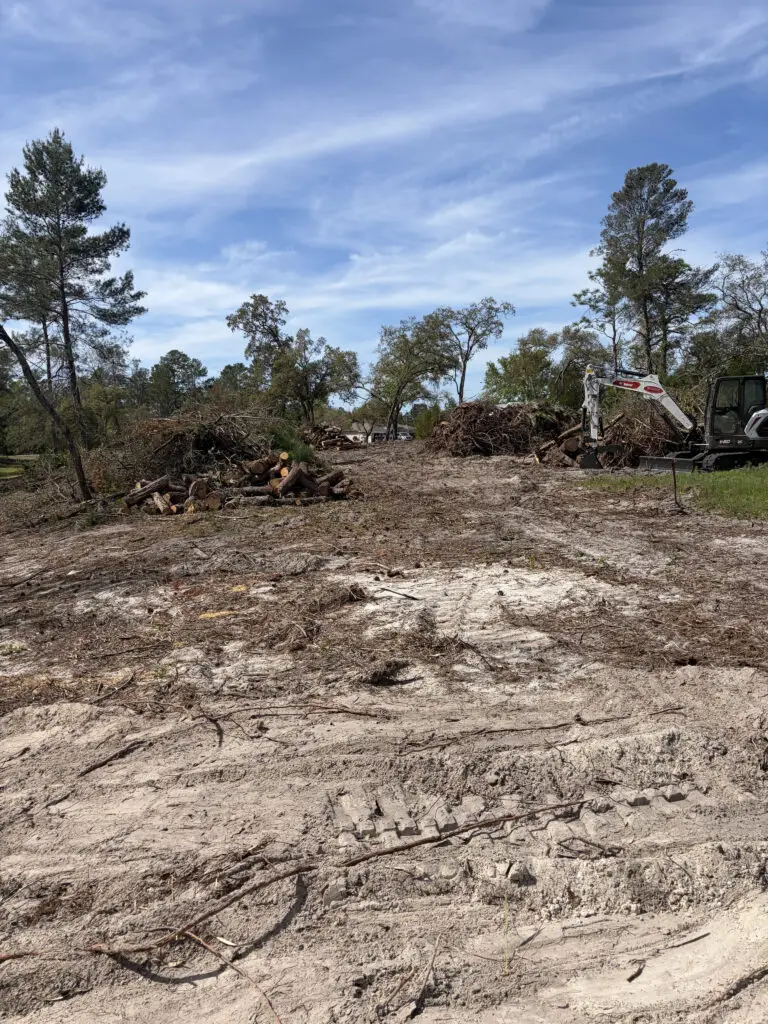
Across Pasco, Hernando, and Citrus Counties, productive pastures don’t stay productive without active management. Saw palmetto spreads from the edges inward. Scrub oak and sand pine colonize the gaps. Gallberry and wax myrtle fill in low spots. Within a few dry seasons, a working pasture becomes a palmetto thicket — and restoring it is harder than it would have been to manage it. H&R Landworks specializes in pasture clearing and reclamation for cattle ranchers, hobby farms, horse properties, and large-lot landowners throughout the Nature Coast region. We bring the right equipment, know Florida terrain, and don’t leave until the job is done right.
What Pasture Clearing Actually Involves
Pasture clearing — also called pasture reclamation — is the systematic removal of encroaching brush, scrub growth, palmetto clusters, and invasive vegetation from established or former pasture land to restore productive grazing, hay production, or open land use. In west-central Florida, the primary encroachment species are saw palmetto, scrub oak, sand pine, gallberry, and in wetter areas, Carolina willow and elderberry along wetland edges. Saw palmetto is particularly aggressive — its rhizomatous root system grows laterally underground and resprouts from root mass if not properly addressed at grade. Effective pasture reclamation requires equipment capable of cutting and grinding at the soil line, not just topping the vegetation. A skid steer with a forestry mulching head is well-suited to light-to-moderate palmetto and scrub oak encroachment, grinding material in place and returning organic matter to the soil without creating burn piles or hauling costs. Heavier density or multi-acre projects may call for a track loader with a high-flow mulching head capable of handling larger material at higher daily acreage rates. Following clearing, root raking removes residual root mass and prepares the surface for overseeding with bahia grass, bermuda, or your preferred pasture grass species.
Our Pasture Clearing Process
Restoring an overgrown pasture is a multi-step process — here’s how we approach it.
Step 1 — Site Assessment & Vegetation Mapping
We walk your pasture and identify encroachment zones, assess the density and species composition of the brush, locate any wetland boundaries, and map out the clearing approach. This assessment determines whether forestry mulching, track loader clearing, or a combination is the right method for your specific acreage and vegetation type.
Step 2 — Equipment Selection & Mobilization
For light palmetto and scrub oak encroachment, a skid steer with mulching head is efficient, precise, and low-impact on existing grass root structure. For heavy multi-acre palmetto thickets or larger-diameter scrub trees, we bring heavier iron. We select equipment for the job, not for convenience.
Step 3 — Brush & Palmetto Clearing
We clear in systematic passes, grinding encroachment vegetation to grade. For saw palmetto specifically, grinding at or below the crown level — not simply topping — significantly reduces re-sprouting. Material is mulched in place, creating a protective layer that suppresses regrowth and decomposes into the soil over time.
Step 4 — Root Raking & Surface Preparation
Following clearing, we root-rake the reclaimed area to remove residual root mass and create a clean, workable surface. This step is especially important on parcels destined for overseeding or where the property owner wants to bush-hog the area going forward without equipment damage.
Step 5 — Final Grade & Handoff
A final pass levels any uneven areas created during clearing. You receive a clean, accessible pasture surface ready for overseeding, fencing, or continued management. We walk the cleared area with you before loading out.
Serving Pasco County, Hernando County & Surrounding Areas
H&R Landworks serves property owners, farmers, hunters, and developers across Pasco County, Hernando County, Citrus County, and Sumter County — with select projects in Levy and Marion Counties for the right scope of work.
In Pasco County, we work throughout Hudson, New Port Richey, Port Richey, Holiday, Trinity, Shady Hills, Land O’ Lakes, Wesley Chapel, Zephyrhills, Dade City, and San Antonio. In Hernando County, our crews cover Spring Hill, Brooksville, Ridge Manor, Weeki Wachee, Masaryktown, and all communities along the Suncoast Parkway. Citrus County work includes Inverness, Crystal River, Lecanto, and Homosassa. Sumter County includes Bushnell, Webster, and the communities surrounding The Villages corridor.
See our full list of services — including land clearing, forestry mulching, stump removal, rough grading, and driveway installation.
Why Pasco & Hernando County Property Owners Choose H&R Landworks
H&R Landworks is owner-operated, which means Dylan Reeves is on-site for your estimate and on-site for your job. No subcontractors, no crews you’ve never met. We run three machines, carry full insurance, quote everything in writing, and communicate from first call through final walkthrough.
H&R Landworks has local knowledge of west-central Florida’s terrain, soil types, and vegetation patterns that matters on pasture work. We know the difference between a Myakka fine sand flatwoods parcel in western Pasco and a sandhill pasture on the Brooksville Ridge — and we select equipment and clearing approach accordingly. We’re not a landscape company doing occasional field clearing; land and pasture work is our primary business.
Learn more about our approach.
Services That Often Pair With Pasture Clearing
- Brush Removal — heavy palmetto and scrub layers may benefit from a focused brush pass.
- Trail and Fence Line Clearing — clear the perimeter so you can run fence.
- Stump Removal — for pasture you’ll be cutting hay on or running equipment over.
- Forestry Mulching — the in-between option for fields where you don’t want piles or hauling.
Get a Free Pasture Clearing Estimate
Whether your pasture is a couple acres or a couple dozen, we’d be glad to take a look and put together a real estimate.
Call 352-296-6726 or request a free estimate.
Frequently Asked Questions About Pasture Clearing
Will the grass grow back on its own? Sometimes, depending on what grass was there originally and how thick the brush layer is. Often you’ll get partial regrowth and need to disc and seed for full coverage. We can give you a sense of what to expect for your specific field after we walk it.
Should I clear stumps if I’m just going to graze cattle? For grazing only, you can often leave smaller stumps and let them rot. For hay cutting or anything where you’re driving equipment across the field regularly, stumps need to come out. Tell us how you plan to use the pasture and we’ll plan accordingly.
Can you clear pasture without killing the existing grass? We try, especially in spots where grass is still hanging on. But realistically, a heavy clearing job is going to disturb some ground. The good news is grass usually comes back fast once the brush is off and sunlight gets in.
What time of year is best for clearing pasture? Drier months tend to be easier on the field — wet ground means more ruts and slower work. That said, we work year-round, and Florida doesn’t always give you a long dry window. If you’ve got a specific timeline, we’ll plan around it.
Can you handle pasture with wetland edges or low spots? Yes, but wetlands have rules. We’ll work around protected areas and flag anything that looks like it needs a closer look. Wetlands permitting is the property owner’s responsibility, but we’ll point out what we see.
How often does pasture need to be re-cleared once you’ve done it? Depends on how you maintain it. A field that’s grazed, mowed, or hayed regularly stays clear for years. A field that goes back to sitting will start growing brush again within a few seasons. Routine bush hogging once or twice a year goes a long way.