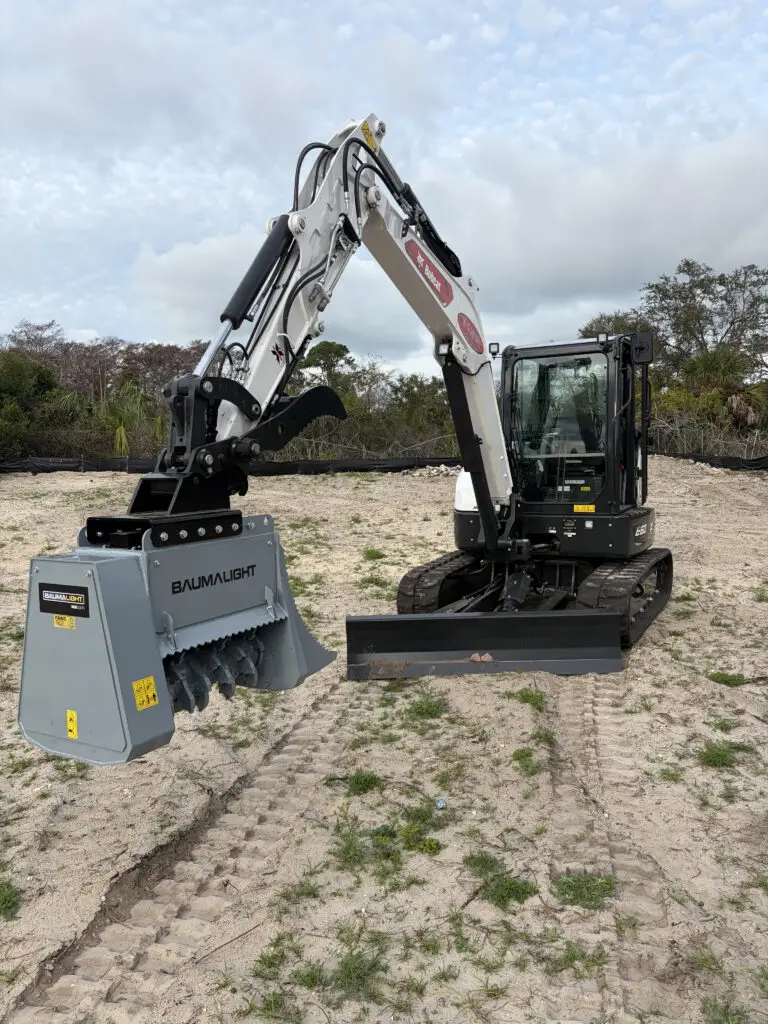
Forestry mulching is the most efficient, lowest-impact land clearing method for the majority of west-central Florida properties. A single machine — a skid steer or compact track loader fitted with a drum mulching head — cuts, grinds, and spreads all vegetation in a single pass. No burn piles, no debris hauling, no stripped topsoil. H&R Landworks provides professional forestry mulching throughout Pasco, Hernando, and Citrus Counties for land clearing, pasture reclamation, trail cutting, fence line clearing, brush removal, and hunting property improvements.
What Forestry Mulching Actually Involves
Forestry mulching is a single-machine land clearing method that uses a rotary drum head fitted with carbide-tipped steel teeth to cut, shred, and spread vegetation in a single pass. Unlike conventional clearing that requires separate equipment for felling, pushing, piling, and burning or hauling, a forestry mulcher handles all of those steps simultaneously. The mulching head spins at high RPM, cutting through trees, brush, vines, and palmetto at grade level and ejecting shredded material backward as a uniform mulch layer. A drum mulcher mounted on a skid steer handles material up to approximately six to eight inches in diameter. For larger-diameter material, the process slows down but remains effective. The mulch layer left behind serves several important functions: it protects the soil surface from erosion during Florida’s intense summer rains, suppresses weed and brush regrowth, decomposes into organic material that improves soil health, and creates a stable, walkable surface for trails and cleared corridors. For Florida’s sandy, erosion-prone soils — particularly the Myakka and EauGallie fine sands common throughout western Pasco County — mulching in place is significantly better for long-term soil health than conventional clearing that strips and exposes bare sandy substrate. Forestry mulching does not address large stumps — those require dedicated stump grinding as a follow-up step for construction or development applications.
Our Forestry Mulching Process
Forestry mulching is efficient by design — but it still requires proper setup and execution for clean results.
Step 1 — Site Assessment & Method Confirmation
We walk your property and confirm that forestry mulching is the right method for your vegetation type, density, and project goals. For very heavy density (large-diameter timber, dense palmetto mats), we may recommend a combination approach. We also confirm whether any large stumps require separate grinding after the mulching pass.
Step 2 — Mulching Head Configuration
Our skid steer mulching head is configured and inspected before each job — teeth checked for wear, hydraulic connections verified, and head speed calibrated. A well-maintained mulching head produces consistent fine mulch and moves at proper productivity rates. Under-maintained equipment produces poor mulch quality and slow progress.
Step 3 — Systematic Clearing Passes
We work in systematic passes across the clearing area, overlapping slightly for complete coverage. Approach angle, pass speed, and RPM are adjusted in real time based on material density. Dense palmetto clusters and larger-diameter stems require slower passes and proper head engagement to grind at grade rather than simply shred above it.
Step 4 — Mulch Distribution
Material is distributed as a uniform layer across the cleared surface. For trail cutting and corridor work, we control the spread to keep mulch within the corridor. For open-area clearing, a consistent 2–4 inch mulch layer is the target.
Step 5 — Stump Follow-Up (If Required)
For construction applications or parcels where complete below-grade clearing is needed, a stump grinding pass follows the mulching to address any stumps left at or above grade. This is quoted and scheduled as part of the overall project.
Serving Pasco County, Hernando County & Surrounding Areas
H&R Landworks serves property owners, farmers, hunters, and developers across Pasco County, Hernando County, Citrus County, and Sumter County — with select projects in Levy and Marion Counties for the right scope of work.
In Pasco County, we work throughout Hudson, New Port Richey, Port Richey, Holiday, Trinity, Shady Hills, Land O’ Lakes, Wesley Chapel, Zephyrhills, Dade City, and San Antonio. In Hernando County, our crews cover Spring Hill, Brooksville, Ridge Manor, Weeki Wachee, Masaryktown, and all communities along the Suncoast Parkway. Citrus County work includes Inverness, Crystal River, Lecanto, and Homosassa. Sumter County includes Bushnell, Webster, and the communities surrounding The Villages corridor.
See our full list of services — including land clearing, forestry mulching, stump removal, rough grading, and driveway installation.
Why Pasco & Hernando County Property Owners Choose H&R Landworks
H&R Landworks is owner-operated, which means Dylan Reeves is on-site for your estimate and on-site for your job. No subcontractors, no crews you’ve never met. We run three machines, carry full insurance, quote everything in writing, and communicate from first call through final walkthrough.
Forestry mulching is H&R Landworks’ primary clearing method for the majority of west-central Florida projects. It’s faster, cleaner, and better for your soil than conventional clearing. We run production-grade mulching heads — not undersized brush cutters dressed up as mulchers — and our operators are experienced in reading Florida vegetation and adjusting approach accordingly. The difference between a professional forestry mulching job and a poor one is visible immediately in the mulch quality and the treatment of material at grade.
Learn more about our approach.
Services That Often Pair With Forestry Mulching
- Brush Removal — for thicker, larger brush jobs.
- Trail and Fence Line Clearing — mulching is often the finishing step on cleared trails.
- Land Clearing — for larger or heavier material that’s beyond the mulcher’s sweet spot.
- Hunting Property Improvements — mulching is a great fit for hunting trails and sight lanes.
Get a Free Forestry Mulching Estimate
If you’ve got pond banks, retention areas, trails, or property lines that need opening up without the mess, mulching may be the right call.
Call 352-296-6726 or request a free estimate.
Frequently Asked Questions About Forestry Mulching
What size trees can you mulch? Our light mulching equipment is dialed in for the 2-to-6-inch range. We can handle some material outside that on either end, but the work goes fastest and looks cleanest in that sweet spot. Bigger trees are usually better handled with traditional tree removal or full clearing.
Will the mulch hurt my pond bank or grass? No, the opposite — mulch helps suppress weed regrowth and reduces erosion. On a pond bank, leaving a layer of mulch tends to be a feature, not a problem. If you want bare ground after, that’s a different (heavier) service.
How long does mulched material take to break down? Usually one to two years in Florida’s climate, depending on the species and how thick the layer is. By the time it’s gone, the ground underneath is usually doing better than it was.
Can you mulch around trees I want to keep? Yes. The whole point of light mulching is precision. We work around what you want to keep and only mulch the target material.
Is forestry mulching cheaper than traditional clearing? Sometimes yes, sometimes no — it depends on the property. Mulching saves on debris removal and burn piles, which can make it more affordable for the right kind of job. For dense, large-material clearing, traditional methods are often more efficient. We’ll be honest about which makes sense.
Will the brush grow back? Lighter brush often does send up new growth, especially palmetto. Mulching knocks it back significantly and the mulch layer slows regrowth, but for permanent control you’d either need to maintain it (a yearly pass) or look at full root removal.