

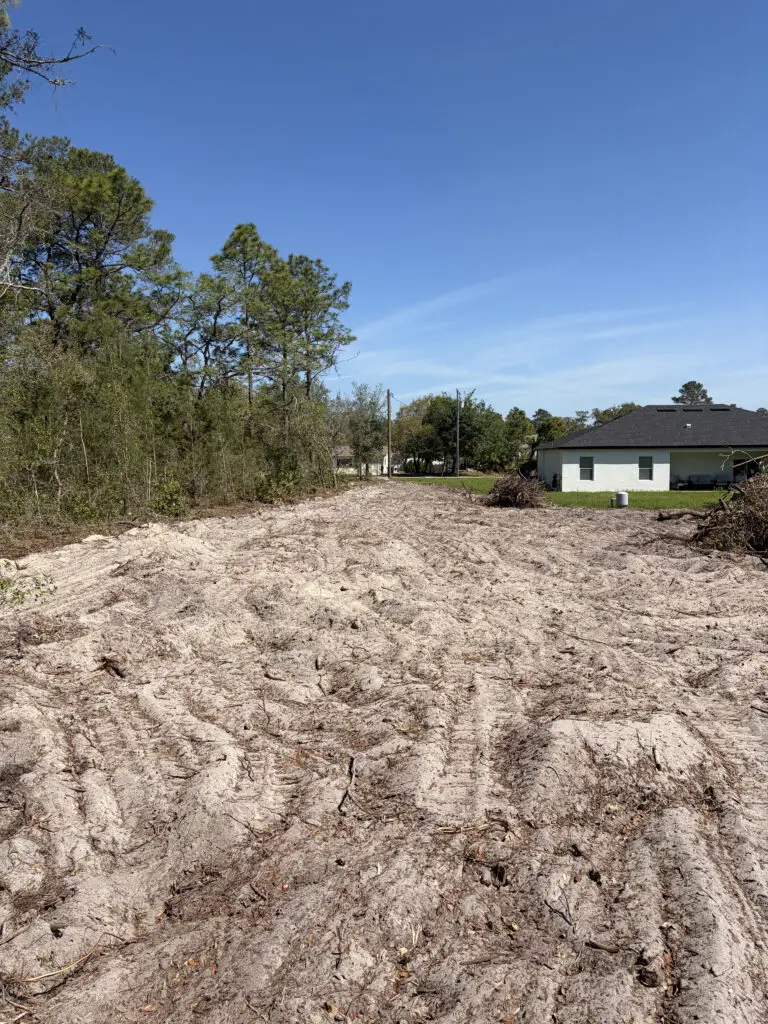
A poorly installed driveway washes out after the first summer storm, ruts under any real vehicle weight, and costs more to fix than it would have cost to do right the first time. H&R Landworks installs gravel and limerock driveways throughout Pasco and Hernando Counties — properly cleared, graded, compacted, and surfaced to handle Florida’s weather and daily use. Whether you’re installing a new driveway on a raw lot, extending an existing drive, or replacing a washed-out surface, we build it to last.
What Driveway Installation Actually Involves
Driveway installation on Florida rural and semi-rural properties involves four sequential phases: corridor clearing, subgrade preparation and grading, compaction, and surface material installation. Each phase directly affects the performance of the next. Corridor clearing removes all vegetation, roots, and stumps from the driveway path — organic material left in the subgrade decays over time, creating voids that cause surface settling and cracking. Subgrade preparation establishes the crown or cross-slope of the driveway — typically a 1–2% cross-slope that sheds water to the edges — and excavates the corridor to the depth required for the planned surface material and base. In Florida’s sandy soils, adequate subgrade compaction is critical: loose sand shifts under daily vehicle loads and erodes rapidly under surface water flow. The compacted subgrade is topped with a base layer of crushed limerock — the standard base material in west-central Florida — spread in controlled lifts and compacted to density. The surface finish may be additional limerock, crusher run, recycled concrete (reclaimed asphalt pavement), or left as compacted limerock, depending on the property owner’s preference, budget, and traffic load requirements. Culvert installation at ditch crossings is included where required to maintain drainage under the driveway. H&R Landworks handles the clearing, grading, compaction, and material installation phases; asphalt and concrete paving require a separate specialized contractor.
Our Driveway Installation Process
A driveway is only as good as the foundation under it. Here’s how we build one that lasts.
Step 1 — Corridor Staking & Clearing
We stake the driveway centerline and width, then clear the full corridor of all vegetation, stumps, and root material. Surface roots within the driveway footprint are ground or raked out — organic material left under limerock base decays and creates settling voids. The corridor is cleared to bare mineral soil before any grading work begins.
Step 2 — Subgrade Excavation & Grading
We excavate the corridor to the appropriate depth for the planned surface (typically 6–8 inches total depth for limerock surface, deeper if asphalt or concrete is planned). Cross-slope is established at this phase — a 1–2% crown or one-direction slope ensures water drains to the ditch rather than pooling on the driving surface.
Step 3 — Subgrade Compaction
The excavated subgrade is compacted using mechanical compaction equipment in passes sufficient to achieve a stable, dense surface. Loose sand subgrades compact significantly under initial compaction — we account for this in excavation depth so the final grade is correct after settlement.
Step 4 — Limerock Base Installation & Compaction
Crushed limerock is spread in controlled lifts (typically 3–4 inch lifts) and compacted after each lift. Limerock is the standard base material for driveways in Pasco and Hernando Counties — it’s locally available, compacts well into a dense, stable matrix, and supports vehicle loads without shifting. The number of limerock lifts depends on total design depth.
Step 5 — Culvert & Final Surface
At any ditch or drainage crossings, a culvert pipe is installed and backfilled with limerock at the correct invert elevation to maintain drainage flow. The final surface layer is spread, shaped to final cross-slope, and compacted. We walk the completed driveway with you to confirm grade, drainage, and surface condition before loading out.
Serving Pasco County, Hernando County & Surrounding Areas
H&R Landworks serves property owners, farmers, hunters, and developers across Pasco County, Hernando County, Citrus County, and Sumter County — with select projects in Levy and Marion Counties for the right scope of work.
In Pasco County, we work throughout Hudson, New Port Richey, Port Richey, Holiday, Trinity, Shady Hills, Land O’ Lakes, Wesley Chapel, Zephyrhills, Dade City, and San Antonio. In Hernando County, our crews cover Spring Hill, Brooksville, Ridge Manor, Weeki Wachee, Masaryktown, and all communities along the Suncoast Parkway. Citrus County work includes Inverness, Crystal River, Lecanto, and Homosassa. Sumter County includes Bushnell, Webster, and the communities surrounding The Villages corridor.
See our full list of services — including land clearing, forestry mulching, stump removal, rough grading, and driveway installation.
Why Pasco & Hernando County Property Owners Choose H&R Landworks
H&R Landworks is owner-operated, which means Dylan Reeves is on-site for your estimate and on-site for your job. No subcontractors, no crews you’ve never met. We run three machines, carry full insurance, quote everything in writing, and communicate from first call through final walkthrough.
Driveway installation in Florida’s sandy soils rewards attention to subgrade preparation more than any other single factor. A driveway with a properly cleared, compacted subgrade under an adequate limerock base outlasts one built on disturbed sandy soil by years. H&R Landworks approaches every driveway with the subgrade as the primary focus — not just dumping and spreading limerock on top of whatever was there before.
Learn more about our approach.
Services That Often Pair With Driveway Installation
- Land Clearing — new properties usually need the driveway path cleared.
- Rough Grading — proper grading is the base of every driveway.
- Stump Removal — for any stumps on or near the driveway route.
- Skid Steer Services — for shorter driveways and tight-access work.
Get a Free Driveway Estimate
New driveway, replacement driveway, or a washed-out mess that needs to be done right this time — call at (352) 251-1095 or request a free estimate.
Frequently Asked Questions About Driveway Installation
How long should a properly built driveway last? A driveway with a good base and the right material, maintained reasonably (one quick top-up and grade pass every few years), will hold up for a long time. The driveways that fail in a year or two are the ones where the base was wrong, the crown was wrong, or the material was wrong for the conditions.
What kind of material do you recommend? Depends on the property. Gravel, limerock, and shell all have their place. We’ll talk through your priorities — how it drives, how much maintenance you want, look, cost — and recommend what fits. We won’t push the most expensive option just to push it.
Can you fix a driveway that keeps washing out? Usually, yes — but the fix is rarely “more material on top.” Washouts come from bad grading, no crown, or no proper base. We’ll diagnose what’s actually causing the problem and quote the real fix, not a band-aid.
Do I need a permit to put in a new driveway? Sometimes. If the driveway connects to a county or state road, you may need a driveway permit or culvert permit. The county is usually pretty straightforward about this. We’ll flag what we know and you’ll handle the application — or we can talk through who in your county to call.
Can you put in a culvert if my driveway needs one? Yes, where the situation calls for it. Roadside ditches often need a culvert under a new driveway. We’ll plan for it during the estimate and price it in.
How long does it take to install a driveway? A short residential driveway can often be done in a day. Longer rural driveways with full base prep can take two or three days. Driveways that need significant clearing or grading first add time to the front end. We’ll give you a realistic timeline with the estimate.